
Football History: Nose Guards and Face Masks
- christinerachelle
- Aug 24
- 3 min read
Oh my, my, the Football Archaeologist has done it again, a fun deep dive into equipment. While searching to see when the Tenite plastic facemasks were removed from football helmets after they were introduced in the 1950's (check out the 1954 Wilson Football catalog to see them when they were introduced) the ever-so-knowledgeable Timothy Brown came through again. With his permission, here's the start of some fantastic history, and you can finish on his Substack page.
The equipment used by football players at different points in the game's history tells us much about the game during each period, making period sporting goods catalogs an interesting archival source of football history. My first post examining catalog items covered the history of footballs and the equipment needed to maintain them, while the second post dealt with football shoes and cleats. The series now turns to facial protection. That is, the methods of protecting players' faces before helmets, during the leather helmet days, and in the first twenty years of plastic helmets.
Early football players did not wear equipment to protect their heads or faces, but particular rules changes led football away from the open rugby-style game of the 1870s and 1880s to the slug-it-out, mass game of the 1890s. The increased number of collisions and piles brought more broken noses, black eyes, and similar injuries, leading Harvard's captain, Arthur Cumnock, to devise the nose guard in 1892. Cumnock sold his rights to the device to John Morrill, who modified and commercialized the nose guard.
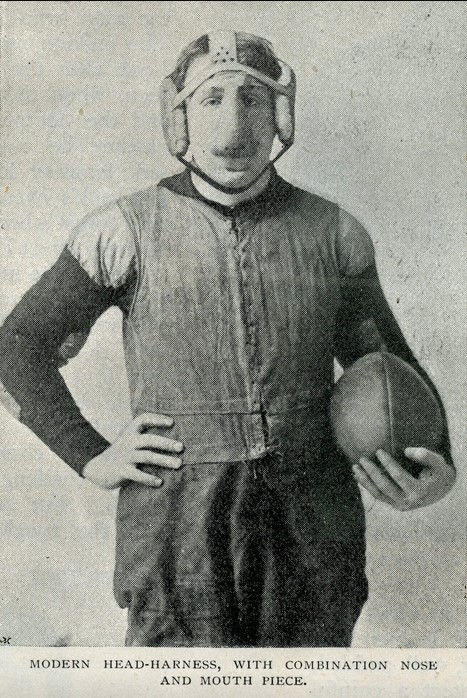
In an age when the amount of protective equipment worn by a player was considered inversely related to one's manhood, most who wore a nose guard had existing facial injuries or strong-willed mothers. Even then, the nose guard was less than ideal since players with broken noses had difficulty breathing through the nose. At the same time, clenching the device between the teeth made it difficult to breathe through the mouth.
The use of nose guards peaked by 1910 but remained in use and available in sporting goods catalogs until the 1940s. Notably, during much of the nose guard's reign, players did not wear helmets per se; as seen in the image above, they wore head harnesses that more closely resembled today's wrestling headgear than modern football helmets.

The 1920s and 1930s saw football's flimsy headgear shift toward rigid helmets with hard protective shells encased in softer leather. The nose guards of the 1890s, which rested on the face, evolved into partial and full-face masks. Fiber- and steel-reinforced, some strapped around the head while others attached to the helmet, covering the face.

Another form was the executioner's mask, which is the likely reason we call today's devices face masks.) These limited peripheral vision and were exceedingly hot, but they were effective in protecting previously broken noses. It is fair to assume that no one wore these devices without a pre-existing condition.

The increasing rigidness of helmets led to the next great leap in facial protection with the birdcage's arrival. Unlike devices that rested on the face, birdcages protected the nose and eyes by attaching to and extending from the rigid helmet. Besides protecting facial injuries, they also allowed players to wear eyeglasses while playing football. Again, these were worn exclusively by players with injuries or eyeglasses...
[Read the rest, with more awesome photos that include the clear plastic masks, here: https://open.substack.com/pub/browntim/p/the-history-of-football-as-told-by-sporting-goods-catalogs-pt-iii?r=487m55&utm_campaign=post-expanded-share&utm_medium=web]


Comments